We've detected that you're using an unsupported browser. You may experience issues using the OA website. Please visit our supported browsers page for more information.

US Enters Korean War

The Korean war began on June 25, 1950. The Korean peninsula had been ruled by Japan since 1910 and following the surrender of Japan at the end of World War II, Korea was divided along the 38th Parallel with United States troops occupying the Southern part and Soviet troops occupying the Northern part.

2


Truman Becomes President

Truman took office as the 33rd President of the United States three months into Roosevelt’s fourth term following Roosevelt's death. It was a rough time, and World War II was still raging. Truman was the one who made the decision to utilize the atomic bomb – a controversial decision.

Harry S. Truman was a strong supporter of the Boy Scouts. In addition to being the Honorary President of the BSA, Truman personally attended and opened the 1950 National Scout Jamboree at Valley Forge, PA.

2, Non-Scouting


Japan Surrenders Ending WW II

World War II ended within days of the United States dropping of Atomic bombs over the cities of Hiroshima and Nagasaki. Japan unconditionally surrendered on September 2, 1945.  Both Goodman and Edson lost sons during the war. George Goodman and Stuart Edson were killed in action in Europe. Edson, having served in the reserve since his service in World War I returned to active duty as a lieutenant colonel and then attained the rank of Colonel shortly before his discharge in 1945.

2, Non-Scouting


14th & Last "National Meeting" Held

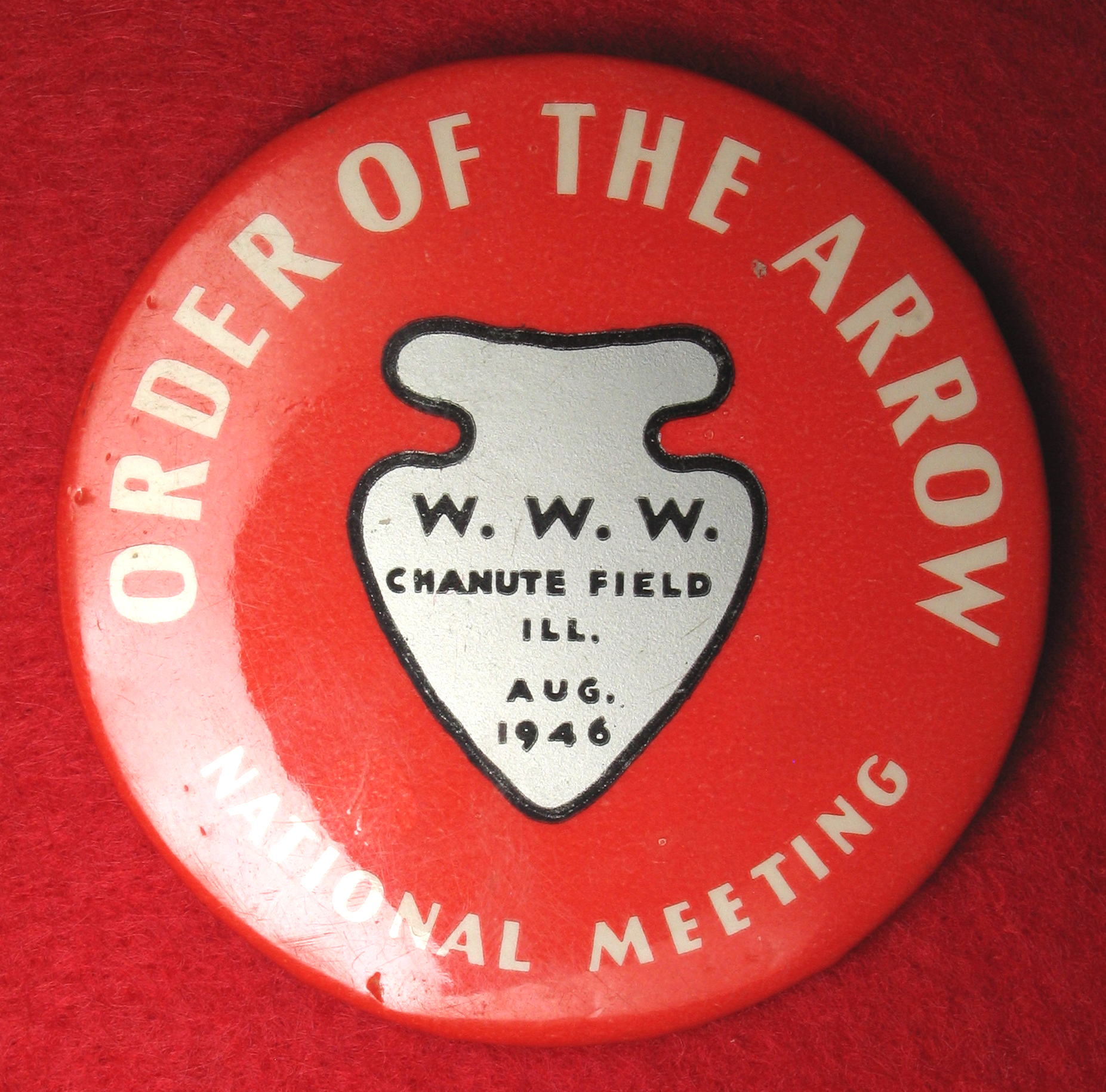
After World War II, National Lodge could meet again. The original plan was to hold the 1946 meeting where the 1942 National Meeting had been scheduled. However, with all of the returning military the University of North Carolina, Chapel Hill informed the National Lodge that they would not have the dorm space available. The OA was now too large to meet at a Scout camp and universities were filled with returning military. An alternate site was needed.

984 delegates from 114 lodges (both records) descended upon Chanute Field Army Air Corp in Illinois. The Arrowmen bunked in the more than ample barracks. Owasippe Lodge, Chicago took the traditional role of a host lodge handling registration and other activities. Even though Chicago was over 100 miles away, Owasippe was the only lodge with the Arrow-power to handle the responsibilities.

Surprisingly, there was insufficient time to hold the very successful classes and group sessions presented at the 1938 and 1940 National Lodge Meetings. The OA Distinguished Service Award was presented. The meeting was set on a tight schedule with the opening on a Tuesday at 2:00 PM and ending on Thursday at noon.

1946 was the last meeting with elections of adult leadership. Robert H. Heistand of Nentico Lodge, Baltimore, Maryland was elected National Chief. John C. Norsk from Allogagan Lodge, Springfield, Massachusetts was elected to a second term as National Secretary. J. Rucker Newbery was elected National Treasurer. The National Executive Committee was expanded. The two immediate past National Chiefs would be on the board. They were H. Lloyd Nelson and George Mozealous. Four other committeemen were elected, each from a different geographical section of the country. Elected to the committee were G. Kellock Hale, Jr., John M. Pfeil, Herbert L. Gaskin and Andrew R. Groenink. In addition the National Council had two representatives, Founder E. Urner Goodman and Director of Camping Wes Klusmann.

1946 would be the last “National Lodge Meeting” (verbiage on the 1948 patch notwithstanding). From humble Grand Lodge Meetings with fewer than 10 lodges and less than 20 delegates the OA had become an official BSA program. In 1948 the Order of the Arrow would be fully integrated into the BSA. What would come next would be a NOAC!

2


NBA Begins

The NBA was founded as the Basketball Association of America on June 6, 1946. The first game was played between the New York Knickerbockers and the Toronto Huskies. The league changed its name to the National Basketball Association, (NBA) when the BAA merged with the rival National Basketball League (NBL) in 1949.

2, Non-Scouting


First Modern Day African American Baseball Player

Jackie Robinson became the first African American to play modern Major League Baseball on April 15, 1947 at Ebbets Field, Brooklyn, New York. Born in Georgia, the son of sharecroppers, the youngest of five children (Brother “Mack” won a Silver Medal behind Jesse Owens in the 200 Meter Dash at the 1936 Olympics), Robinson went to UCLA and served his nation in the military.

2, Non-Scouting


J. Rucker Newbery

J. Rucker Newbery is best known as the editor of the first Order of the Arrow Handbook in 1948. Newbery officially joined the OA on June 11, 1936 when he chartered the Bob White Lodge, Augusta Georgia into the Order while serving as their Scout Executive. Newbery remained a member of the Order until his death in 1978.

Early in 1942 Frank Dix of the National Executive Committee tendered his resignation. Dix had been selected to the National Executive Committee as the Southern representative. When he was re-assigned by the national office as a Deputy Regional Executive to Cincinnati, he could no longer serve. It was a national BSA policy requiring balance on the lead OA committee that a Southern representative was required on the committee. Dix suggested J. Rucker Newbery as his replacement and in 1942 Newbery was appointed to the National Executive Committee.

In 1943 Newbery transferred to Charleston, South Carolina and became Scout Executive of Coastal Carolina Council. He immediately chartered Unali’yi Lodge. In 1946 Newbery was elected National Lodge Treasurer at the National Meeting at Chanute Field. Newbery also kept his Vigil at the 1946 Meeting and was given a Vigil name meaning “The Willing One”.

In 1948 J. Rucker Newbery edited the first Order of the Arrow Handbook. The book was an immediate success and was a requisite requirement for the OA becoming fully integrated into the BSA. Newbery was also an early patch collector. The OA Handbook was the first time groups of patches were photographed for members. This contributed to the growth of patch trading. Newbery was honored for his leadership and service with the OA Distinguished Service Award in 1948, a time when there had been fewer than 25 recipients.

2


OA Official Part of BSA

It was announced at the 1948 NOAC that the Order of the Arrow would be fully incorporated into the Boy Scouts of America. In a process that had started in 1921 with the first national organization, the Order of the Arrow had finally realized its most ambitious and desired goal. This announcement was met with some acrimony from Arrowmen concerned about the BSA taking over the Order. While the national OA leadership had been fully dedicated for over 15 years to achieving this goal, many Arrowmen took pride in the autonomy of the Order.

It had happened incrementally. In 1922 WWW was labeled an Official BSA experiment. Starting in 1932 the OA was thoroughly investigated by the BSA and made a Scout program in 1934, effective January 1, 1935. Once an official program the Order grew rapidly. The OA grew from 43 active lodges at the end of 1934 to 362 active lodges in 1948. The OA had become a true national organization operating in every region of the country.

The OA did have to make some changes to gain full integration into the BSA program. Because of religious objections that had existed for decades regarding the ceremonies everything had to be reviewed and often re-written. Another issue was some members of the OA while elected as Scouts had allowed their BSA registration to lapse. As a BSA run only active members of the Scouts could be active Arrowmen. The OA also had to change some terminology.

There was also an agreement regarding youth leadership. As in Scout troops, leadership positions in lodges and eventually areas and regions would be changes to youth leadership with adult advisers. That however did not affect the national leadership that negotiated with the BSA. The OA would form the National OA Committee and would have their jobs made dramatically easier with BSA supervision. For example, supply problems had beleaguered the OA since the beginning. With the fantastic growth of the Order, it made supplying the local lodges incredibly difficult for volunteer Arrowmen (although many were Scout professionals, this was something they did as volunteers.) Under the BSA, National Supply would take over service to the local lodges. A professional would be provided to the Order to handle the clerical and administrative duties allowing the National OA Committee to focus on other matters such as policy and developing area meetings throughout the Order.

2


History of Pocket Flap

It is strongly recommended by the National Committee that these emblems be made to fit the shape of the right shirt pocket flap. The right shirt pocket flap has been approved by the National Committee on Badges and Insignia for official Order of the Arrow Insignia where the other emblems are only temporary insignia when used on the uniform. It should be realized that this is a great advantage and a compliment to the Order of the Arrow. -THE ORDER OF THE ARROW HANDBOOK pp. 64 & 72, 1954 printing, 1950 edition

In the 1930s the Scout uniform was a showcase for all sorts of colorful Scouting related insignia on the shoulders, sleeves, and collars, as well as above and on the pockets. In fact, the only areas of the Scout uniform spared from this potpourri of decoration were the back of the shirt and pocket flaps. The pocket flap eventually became the official location for wearing Order of the Arrow insignia, but not without a few twists and turns.

The usage of Order of the Arrow insignia posed an interesting dilemma for the Scouting Insignia Committee, since prior to 1935, the Order of the Arrow was not even an official part of the Boy Scout program. Thus, how could OA insignia have any legitimate place on the Scout uniform? Early insignia mostly consisted of totem pins intended for civilian wear only. Those patches that were created typically were for wear on Indian costumes and sweaters.

As time progressed, the idea of OA insignia was encouraged.  In 1945 the OA received approval to wear patches on the Scout uniform.  By 1948, the year the Order of the Arrow was fully integrated into the Boy Scouts of America, the new Order of the Arrow Handbook written by National OA Committee member and long time badge collector J. Rucker Newbery, devoted two entire pages to pictures of local lodge insignia. At the same time that the official Handbook encouraged the use of “cloth insignia” for identification, the 1948 edition of the Order of the Arrow Handbook contained an omission and an inadvertent inclusion that would change the history of OA insignia forever.

The omission was the OA Handbook advocated the use of lodge insignia, but failed to specify where this insignia was to be worn. While such an omission would seem inconsequential at first glance, the official location of no other Scouting insignia was left to the imagination of the wearer. The net result of this omission was that local lodges were left to decide where to wear their insignia.

Several different locations were chosen. Mazasha Lodge of Mankato, Minnesota wore its badge on the right shirt pocket while Ay-Ashe Lodge of Manitowoc, Wisconsin wore its badge on the merit badge sash. Blue Ox Lodge of Rochester, Minnesota wore its badge above the right pocket where a jamboree badge would go, and Chappegat Lodge of New Rochelle, New York wore its badge slightly lower, resting on top of the program strip that said Boy Scouts of America. In yet more examples, Achtu Lodge of Jersey City, New Jersey located its badge on the right shoulder of the uniform and Siwinis Lodge from Los Angeles, California wore a tree-shaped badge on a neckerchief. Massasoit Lodge from Quincy, Massachusetts wore its badge on a Scout jacket and Tamet Lodge from Santa Monica, California wore its badge on the red and white arrow sash. Other lodges still wore their totem badges on Indian costumes and sweaters.

The inadvertent inclusion on page 21 of the 1948 edition of the Order of the Arrow Handbook was profound. At the bottom of that page was pictured a dark badge depicting a leaping stag. Behind the stag was an arrow pointing left. What made this patch remarkable was its shape. While Order of the Arrow badges and totems existed in almost every conceivable configuration, this badge was unique in its squat inverted pentagon form that unmistakably resembled the flap over the pocket of the Scout shirt. In fact, this badge was made in the exact colors of Scout shirts of its day, khaki and “Explorer” green and was worn by its lodge members on the right shirt pocket flap. This was, in fact, the first flap badge.

The members of Ajapeu Lodge of the Bucks County Council, Doylestown, Pennsylvania issued this first flap pre-1947. Unconfirmed reports list the date as early as 1943. It is not known who thought of the idea for a flap-shaped badge or who designed the first flap for Ajapeu Lodge. One story about its inception is that during World War II an unknown Scout’s mother actually embroidered the stag and arrow design directly onto the uniform flap for those Scouts inducted into the OA. Another account has a local tailor embroidering the shirts for the Arrowmen of Ajapeu on the right shirt pocket flap. How much of the story is fact and how much is folklore is not known. What is known is that after World War II this design was Swiss embroidered into large, un-bordered pieces of cotton twill material and then crimped by lodge members to fit the shape of the pocket flap.

The 1948 first edition of the OA Handbook was distributed that summer to the delegates in attendance at the National Conference and many Arrowmen went home with either the flap or the story of the flap insignia from Ajapeu Lodge. As the Handbook was later dispersed to all Arrowmen across the country, every lodge had an opportunity to see the unusual pocket flap badge with the leaping stag. Apparently not many lodges were quick to act. Of the more than two hundred and fifty lodges that had badges by the summer of 1950, less than five of those lodges chose the pocket flap shape and design for their patch.

In fact, the problem still remained: Order of the Arrow insignia had been authorized without specifying the exact location where such insignia was to be worn. This problem was solved in the very next printing of the OA Handbook. On page 62 of the 1950 edition it stated: “It (the embroidered emblem) may be worn on the right shirt pocket of the uniform.” This, of course, was the same location where temporary insignia was worn.

After release of the initial printing of the 1950 edition of the Handbook, an even greater problem was discovered. The BSA Insignia Committee became aware of the fact that the OA Handbook was circulating showing a piece of insignia that was meant to be worn on a place of the Scout uniform that was not allowed. When the second printing of the 1950 edition of the Handbook (in 1951) was published, the picture of the badges now appearing on page 19 had been reshot, being identical to the original photo in every respect except one: the Ajapeu flap was missing and in its place was a round badge from So-Aka-Gha-Gwa Lodge of Bloomington, Indiana.

While some Arrowmen may have noticed the new omission from the Handbook, the vast majority of members were unaware of the fact that pocket flap badges were not allowed. Lodges, apparently oblivious (or in defiance) to the no flap rule, made pocket flap badges.

In 1952, Dwight W. Bischel published The Wabaningo Lodge Emblem Handbook. The first real text on Order of the Arrow badges, Bischel’s book showed seven different lodges having flap shaped emblems. It is now known that there were at least seven other lodges that had flap badges at the time of Bischel’s book.

By the 1953 National Scout Jamboree in California, the notion of the pocket flap was catching on, and certainly those in attendance could not help but notice the proliferation of pocket flap badges worn by the delegates. At this point, the Insignia Committee was faced with a dilemma. On one hand, it could outlaw the unofficial insignia. On the other hand, rather than trying to squash what had become a grass roots movement, it could go with the flow and make official what was already becoming a matter of practice.

In 1954 the BSA National Committee on Insignia declared the right shirt pocket flap as the official location for Order of the Arrow insignia. By 1960, ninety percent of the active lodges wore pocket flap badges. The last active original lodge (Cherokee Lodge, Birmingham, Alabama) to resist developing a flap shaped patch made the conversion complete with the issuance of its first flap in 1973.

2

1942 National Executive Meeting

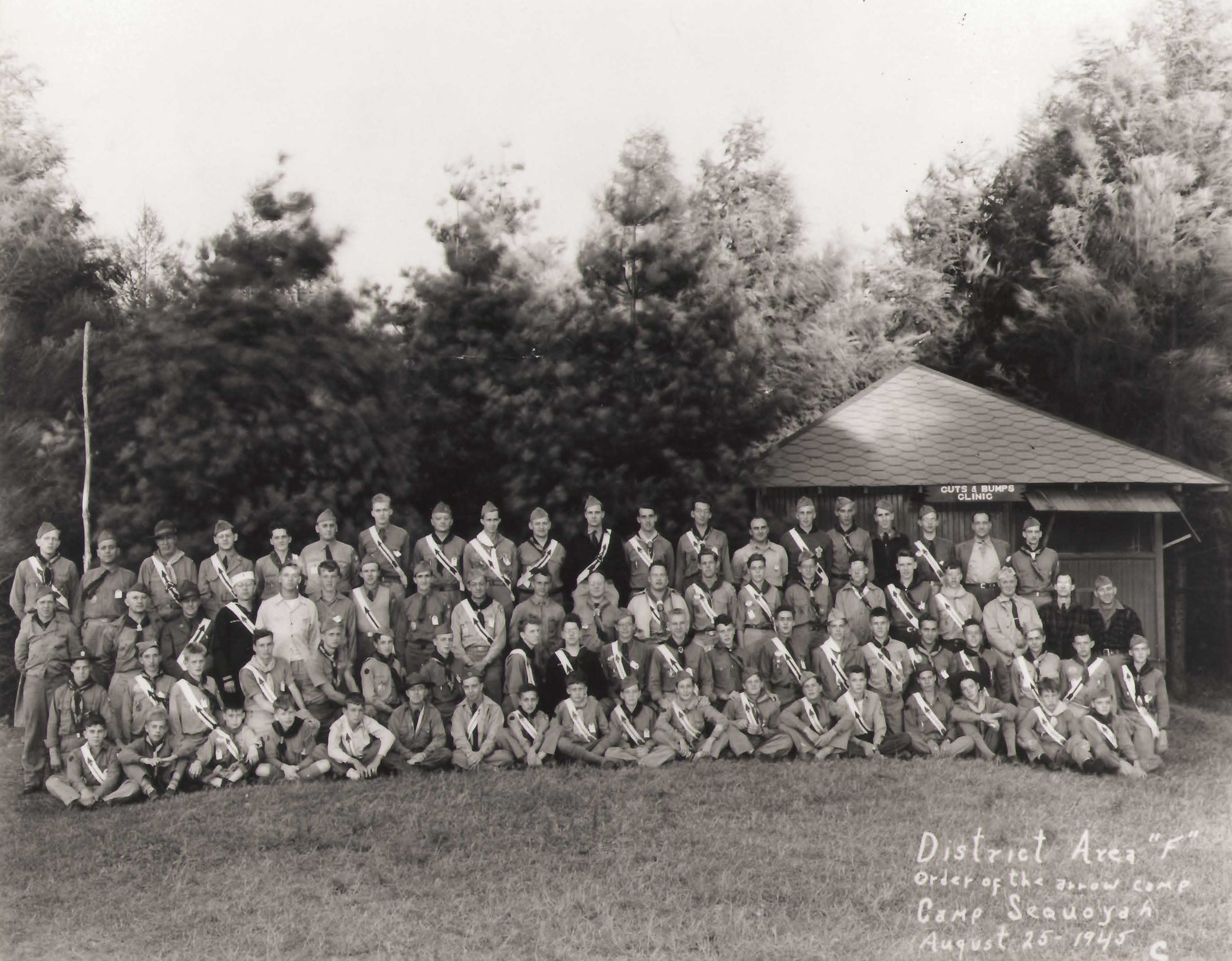
With the cancellation of the 1942 National Meeting due to wartime restrictions a special National Executive Committee meeting was called. It was held on December 27 – 29 at the Hotel Bellevue-Stratford, Philadelphia, Pennsylvania. In some ways the meeting was a throwback to the old Grand Lodge days when the national meeting was held at a hotel.

Joe Brinton served as chairman of the Nominating Committee and reported that as a result of an advisory ballot a slate of officers was nominated and elected. Four-time National Scribe H. Lloyd Nelson of Unami Lodge who had served with distinction since 1933 was selected to serve as National Chief. Nelson became the first non-professional Scouter to serve as Chieftain of Wimachtendienk. John C. Norsk of Allogagan Lodge, Springfield, Massachusetts was selected National Secretary and Richard H. Heistand, Nentico Lodge, Baltimore, Maryland was selected National Treasurer. The other members selected for the National Executive Committee were George Mozealous, Joseph Brinton, J. Rucker Newbery, Herbert L. Gaskin and R. L. Van Horn. George E. Chronic was the new representative selected by the National Council, BSA.

2


250th Lodge Formed

Minnewasco Lodge in Sault St. Marie, Michigan became the Order's 250th Lodge chartering on September 9, 1943. World War II had not slowed the growth of the Order. Indeed, there was as great a need as ever to find young men willing to unselfishly serve others.

2


Goodman & Edson's Sons Killed in WW II

(Do we) find the cost of freedom, buried in the ground
Mother earth will swallow you, lay your body down
Find the cost of freedom, buried in the ground
Mother earth will swallow you, lay your body down
Find the cost of freedom buried in the ground

- lyrics Find the Cost of Freedom by Crosby, Stills, Nash & Young

Having both lived and served through the Great War as young men, the most horrific of personal losses struck the co-founders of the Order of the Arrow in a five week period during World War II.

Both then-Lt. Col. Carroll Edson and E. Urner Goodman lost sons in combat in neighboring corners of the war in Europe.

In October 1944 First Lieutenant Stuart Partridge Edson – Partridge was his mother’s maiden name -- was serving as the Adjutant for the 23rd Armored Infantry Battalion in the area of Overloon, The Netherlands. The 24-year-old Eagle Scout was the Edson’s oldest son.

In those duties Lt. Edson had just signed the official After Action Report of the Battalion for the month of September on 4 Oct. 1944 (military dates place the date first then the month then the year) – placing him near the fluid front, which had degenerated into almost trench warfare.

Lt. Edson and Tech Sgt Norman D. Penn, his driver, were driving from the rear area, at night, to the front line in newly acquired territory. While the territory was a flat area it was festooned with trees and hedges and constantly peppered with shrapnel, rifle and machinegun fire. In the darkness, driving upon unfamiliar roads they apparently took a wrong turn and went missing.

It was not until after the war, when Lt. Col. Carroll Edson urged a British area major who was the administrator for the liberated area to attempt to locate Lt. Edson’s remains. He found them, not in one of the many temporary military graveyards, but in the Trans-Cedron Roman Catholic Cemetery at Oostrum. In August of 1945. The grave was marked with a cross that read "Lt. Stuart Edson / 7 Americk Pz. D. / Born 20/6/1920 / Died 5/10/1944 (European dates feature the day before the month - October 5, 1944).

Interviews with three residents in the area determined that a German soldier, apparently driving a motorbike, brought Lt. Edson’s body to the Marten family in Oostrum. He explained that the officer had died during transit. Lt. Edson’s remains were subsequently relocated to a military cemetery on 5 March 1946.

While Stuart Partridge Edson and Norman D. Penn were dying in Holland, Private First Class George Goodman and his fellow infantrymen of the 324th Infantry Regiment, 44th Infantry Division, were fighting their way towards the German border just above its convergence with Switzerland. PFC Goodman, the youngest son of E. Urner and Louise Goodman, was fighting with the Company B on 14 November 1944 Bravo Company near Embermanil, France.

As he advanced across open terrain towards an enemy-held woods, Private First Class Goodman, acting scout for his squad, was hit in the leg by a sniper’s bullet. He immediately returned the fire, either killing or wounding the enemy sniper. During this action a hostile machinegun located on the edge of the woods opened fire on his squad. With complete disregard for his own safety, Private First Class Goodman gallantly charged the enemy machine gun nest, firing his rifle as he limped into the hail of enemy fire. The courage and fighting spirit displayed by Private First Class Goodman are in keeping with the finest traditions of the Armed Forces. Private First Class Goodman was later reported fatally wounded as a result of this action.

-General Orders Number 182, 8 May 1945 Award, Posthumous, of the Distinguished-Service Cross.

The Distinguished Service Cross is the second highest award for valor awarded by the U.S. Department of the Army exceeded only by the Congressional Medal of Honor. PFC Goodman’s body lies in rest in the American Military Cemetery at Epinal, France.

It is ironic that both Goodman and Edson, two men that devoted their lifetime to serving the young men of America, lost their own young sons in service to the country.

2, Founders, George Goodman, Goodman, OA, Scouting, Stuart Edson