We've detected that you're using an unsupported browser. You may experience issues using the OA website. Please visit our supported browsers page for more information.

Emerson James

Emerson James was presumptively the first African American Vigil Honor member. He was from Woodlawn, located on the South Side of the City of Chicago.

James served as Camp Director for Chicago Council, Douglas Division at Camp Belnap in the 1930s and 40s. In Chicago white Scouts were broken into geographic districts. Black Scouts were all placed in the Douglas Division, the segregated division for all of Chicago. The Scouts of Douglas Division attended Camp Belnap. Belnap was the segregated Scout camp located within Owasippe Scout Reservation, which was located around Whitehall, Michigan.

The Arrowmen from Belnap / Douglas Division were the members of the Takodah Chapter of Owasippe Lodge. James was an early leader of the chapter. Emerson James, along with Horatio W. Isbell and Dr. W. H. Benson are the first known African American Brotherhood members. He took what then was called a blood-rite on November 12, 1932. In 1933 James, along with at least two other Takodah Chapter members attended the 1933 Grand Lodge Meeting hosted by his lodge, Owasippe. This made the 1933 Grand Lodge Meeting the first integrated national OA event.

On October 25,1936 James made another first. Ten weeks after Jesse Owens made his breakthrough with four Olympic gold medals Emerson James became the First African American to keep the Vigil. His Vigil name was Netami, The First.
2


Ninth Grand Lodge Meeting

The Ninth Meeting of the Grand Lodge hosted by Buffalo Lodge (later Sisilija Lodge) at Camp Rotary, Pilot Knob on Lake George, New York was held September 11-13, 1931. At least 15 lodges were in attendance with an unknown number of delegates. The Grand Lodge reaffirmed action of the Grand Lodge in 1927 (although it does not appear in the 1927 minutes) “that the word ‘fraternity’ be replaced with the word ‘brotherhood’ throughout all printed matter.” The Order was starting to pull away from the fraternal roots that influenced its beginnings. The Order was no longer a camp fraternity; it was a brotherhood and had begun using terms that would be more acceptable to the BSA national office. (Note - the Latin root for the word fraternity means brother.)

Another decision made at the 1931 Grand Lodge Meeting, by motion of J. C. Foster of Delmont Lodge, Valley Forge, Pennsylvania, was that the official colors of the Order of the Arrow would be red and white.

A nominating committee created a slate of candidates nominating two Arrowmen for each office. For Grand Chieftain Theodore Shearer of Shaginappi Lodge, Fond du Lac, Wisconsin (although records show Shaginappi Lodge chartered as the sixty-first lodge on March 11, 1932, Theodore Shearer had been with Owasippe Lodge) and Charles M. Heistand of Suanhacky Lodge, Jamaica, New York were the nominees. For Grand Vice Chieftain Myron C. Rybolt from Makajawan Lodge, Highland Park, Illinois and A.P. Newkirk of Wakpominee Lodge, Glens Falls, New York were nominated. The Grand Scribe nominees were Stanley R. Miller, Owasippe Lodge, Chicago and W.F. Livermore, Ajapeu Lodge, Doylestown, Pennsylvania. The nominees for Grand Treasurer were Joseph N. Pattison, Unami Lodge and George Wycoff, Tonkawampus Lodge, Minneapolis, Minnesota.

When nominations were opened up to the floor Grand Chieftain Robroy Price was nominated for an unprecedented second term. To date, no Grand Chieftain had served for two terms and Robroy Price had just served a two-year term with the change in the WWW constitution effective 1927. The nominations closed and Robroy Price was elected to a second term as Grand Chieftain. In the history of the Order of the Arrow, Robroy Price is the only national level chief to be elected to more than one term (H. Lloyd Nelson would later be re-appointed chief during war years). Myron C. Rybolt was elected Grand Vice Chieftain, W.F. Livermore was elected Grand Scribe and Joseph N. Pattison was re-elected Grand Treasurer.

2


First Known African American Second Degree

In November of 1932, the Third Biennial Conference for Region 7 was held at Great Lakes Naval Training Station, Great Lakes, Illinois. 155 Arrowmen attended from five different lodges plus Grand Chieftain Robroy Price in attendance.

On the night of November 12, 1932 fifteen Arrowmen, selected by their lodge or chapter for initiation into the Second Degree, were introduced to the assembly of Arrowmen that included the Grand Chieftain. Among those fifteen were three members of Owasippe Lodge’s Takodah Chapter, the segregated chapter of Chicago. Those three men were Dr. William H. Benson, Emerson James and Horatio W. Isbell. These three men are the oldest known African American members of the Order to become Brotherhood Honor members. That night they received their initiation and sealed their membership in the Order.

The Arrowmen of Takodah Chapter were the Scouts of Camp Belnap, Chicago’s segregated camp. The Scouts of Belnap had been denied entry into the Order as a lodge in 1923 because the Order would not allow more than one lodge per camp and Owasippe Scout Reservation had a lodge. While Goodman was Scout Executive of Chicago the Scouts at Belnap formed Takodah Chapter.

On that November night in 1932, Benson, James and Isbell took what was then known as the Blood-rite Degree. The concept was that two people could be “brothers” by exchange of blood. Today we know that for health reasons the exchange of blood is extremely hazardous and strictly prohibited. However, in 1932 the impediment was a social issue regarding the exchange of blood between races, and not the very real health issue. There is no record, which Arrowmen stood next to the Takodah Arrowmen as their hands were cut open with a knife and they clasped the hand of their new brother by their side. What is known is that they sealed their membership, potentially the first to integrate the Order in this unprecedented manner.

2


Takodah Chapter of Owasippe

When Carroll A. Edson became a Field Executive in 1921 in Chicago Council it was only natural that he would bring Wimachtendienk with him. Chicago in 1921 had five geographic districts and a sixth “division” that was an overlay of the entire council. This division was the Douglas Division and it was for African American Scouts. No matter where in Chicago you lived, if you were Black then you were segregated into the Douglas Division. The Scouts of the Douglas Division also had their own camp, Camp Belnap. Camp Belnap ran the same camp program as the other camps within Owasippe Scout Reservation, except they did not have Order of the Arrow. This was for two reasons. Initially the Grand Lodge would not allow more than one lodge in a camp. But ultimately, the reason Belnap did not have OA was because of the Blood Rite (a ritual exchange of blood between participants) required in the Brotherhood Degree.

When E. Urner Goodman was placed in charge of Chicago in 1927 as Scout Executive he merged together the five Chicago Lodges and they formed the original five chapters of Owasippe. Shortly thereafter, the sixth chapter, Takodah Chapter was formed at Camp Belnap. The Arrowmen of Takodah Chapter are the oldest known African American Scouts in the Order of the Arrow. In 1932 three Takodah Chapter members, Emerson James, Horatio W. Isbell and Dr. William Benson became the first known African Americans to take the Brotherhood Degree.

In 1933 several members of Takodah Chapter including Emerson James and William Benson became the earliest verified African Americans to attend a Grand Lodge Meeting. In 1936 James presumptively became the first African American Vigil Honor member.

Takodah Chapter held social events as any other lodge and chapter of its era. In the 1930s their annual chaperoned dance was the big event. The dance program card from the 1935 Dance held at the renowned Savoy Ballroom is testament to the quality of the event. In the 1940s and 1950s Takodah held chapter fellowships. Eventually segregation ended in Chicago Council and the members of Takodah joined chapters based on their geographic location and not the color of their skin.

2, OA, Profile, Scouting


Roosevelt Elected President

Our nation’s longest-serving President (12 years) took office in 1933 with the promise that he was going to bring the United States out of the Great Depression. President Roosevelt entered the White House already as an active Scouter.  On August 23, 1933 President Roosevelt became the first and only president to be inducted into the Order of the Arrow.  

He served as President of the Greater New York Councils and as president of the New York Boys Scout Foundation. During that time, he led the development of the Ten Mile River Boy Scout Camp (TMR) from 1924 to 1928. In 1930, the BSA presented the Silver Buffalo Award to the then Governor of New York. He utilized the Civilian Conservation Corps (CCC), a part of the New Deal, to build roads that are still used at TMR.  As President in 1937, FDR attended the 1st National Scout Jamboree. Roosevelt ultimately accumulated no less than 24 years of service to the Boy Scouts of America by the time of this death in 1945.

2, Non-Scouting


25th Lodge Formed

On November 27, 1926 Garrison Lodge forms the fifth and last of the original five Chicago Council lodges to form. Carroll A. Edson founded all five of them. Garrison Lodge’s formation marks a milestone in the growth of our Order as the twenty-fifth lodge to charter. Garrison Lodge would later join the other four Chicago lodges when E. Urner Goodman consolidated them together to form Owasippe Lodge.

2, OA, Scouting


Goodman - Chicago Scout Executive

On May 1, 1927 E. Urner Goodman took the helm of Chicago Council as Scout Executive. This was a great professional opportunity for Goodman. Chicago was the largest council in the nation outside New York. And James E. West and the national office dominated New York. Chicago was the most significant Scout Executive position in the BSA. It was a long train-ride away from New York, calling was expensive. Because of this, Chicago had a propensity for doing things their own way. Goodman would bring Chicago Council into national compliance. This position led to a director position in the national office.

2


1927 New York Yankees

The 1927 New York Yankees, featuring the “Murderers Row” of batters is considered by many to be the greatest baseball team ever. The team starred Babe Ruth who broke his own home run record with 60 homers, a .356 batting average and 164 RBIs. Batting behind Ruth was Lou Gehrig whose numbers included 47 home runs, 218 hits, a .373 batting average and 175 RBIs. Tony Lazzari, Bob Meusel, Earle Combs and Mark Koenig completed the “Murderer’s Row”. The Yankees broke the all-time win record posting 110 wins against only 44 losses and went on to win the National League championship in four games.

2, Non-Scouting


Last "Annual" Grand Lodge Meeting

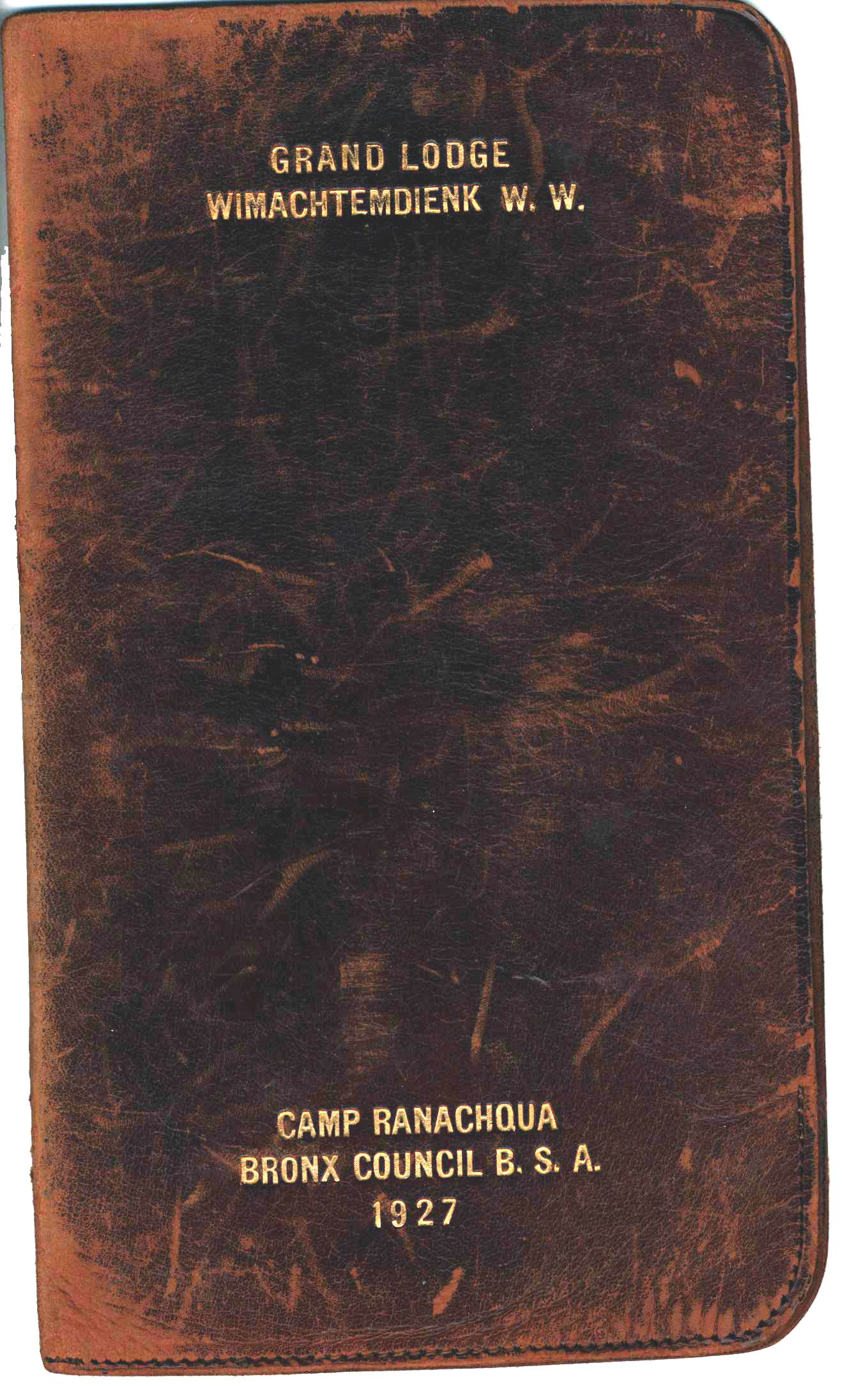
In 1927, the Seventh Meeting of the Grand Lodge was attended by 13 lodges and hosted by Ranachqua Lodge, The Bronx, New York. This was the Grand Lodge’s second visit to Camp Ranachqua, a camp within Kanohwanke Scout Camp near Tuxedo, New York. The number of delegates present is unknown. The first order of business was to finally approve changes in the rituals including the 31-question Brotherhood questionnaire. Additionally, the by-laws were changed to provide for bi-annual Grand Lodge meetings and bi-annual Regional meeting alternating years. Three regions were established utilizing the National Council twelve region system. Regions 1 (New England) and 2 (New York, New Jersey) were combined. Region 3 (Pennsylvania, Delaware, Maryland and Virginia) was not combined with other regions. Regions 7 (Michigan, Illinois, Indiana and Wisconsin) and 9 (Texas, Oklahoma and New Mexico) were the third grouping. Lodges could affiliate with the closest region to them if not included in one of the three groups. The active lodges in Region 10 (Minnesota) ended up affiliating with Region 7 and 9.

While the amended constitution called the regional meetings “Grand Lodge National Council Regional Meetings”, in practice they became known as Regional Grand Lodge Meetings. The new regions would have no real voting power other than making recommendations to the Grand Lodge, however, they were given the power to hold Vigil Degree ceremonies. Previously only the Grand Lodge could initiate new Vigils and lodges were strictly forbidden from performing the ritual. This allowed new Vigils to be initiated every year and more locally than at Grand Lodge and Grand Council meetings.

In elections, Robert S. Henderson of Minsi Lodge, Reading, Pennsylvania defeated Walter G. Seeley of Chappegat Lodge, New Rochelle, New York to become the seventh Grand Chieftain. Allen S. Carpenter of Moqua Lodge, Chicago defeated George Wycoff of Tonkawampus Lodge, Minneapolis, Minnesota to become Grand Vice Chieftain. Harvey A. Gordon of Unami was elected to a 4th term as Grand Scribe running unopposed. Alfred Pancoast of Unami was elected Grand Treasurer defeating Edward B. Malcomson.

2


Eighth Grand Lodge Meeting

For the 1929 Eighth Meeting of the Grand Lodge, the conference returned for a third time to Philadelphia. Unami Lodge once again hosted the 12 lodges in attendance and an unknown number of delegates. The first issue occurred prior to the meeting. Unami Lodge had scheduled the meeting for the week between Christmas and New Years. Many lodges objected to the dates and the meeting was re-scheduled for November 29 – December 1, 1929. The 1929 Grand Lodge Meeting was held at the Stephen Gerard Hotel. The Grand Lodge Scribe announced that there were now 33 active lodges in the Order instead of 37 with the pending Chicago consolidation. Grand Chieftain Robert Henderson made the following statement regarding lodges that desired a change in the democratic method candidates were selected by either blocking some candidates from the ballot or the lodge’s ability to veto/blackball a candidate:

1. That the vote of the Scouts is for the purpose of nominating a Scout whom they think has the proper qualifications for becoming a member of the Order of the Arrow.

And,

2. The ordeal is for the purpose of assuring the members of the Order that the judgment of the voting members has been correct.

Later in the meeting rules were passed for enforcement of these policies.

The Grand Lodge also voted to create a fourth degree, between Brotherhood and Vigil, called the Fellowship Degree. On Carroll A. Edson’s motion, the Grand Lodge agreed to hold off on commencement of the new degree until the ceremony for it had been written. No such ceremony was written and the degree never was utilized.

Robroy Price of Buffalo Lodge in Schenectady, New York was elected the Grand Chieftain. Alfred Nichols of Owasippe Lodge, Chicago, was elected Grand Vice Chieftain. Benjamin J. Thomas of Octoraro Lodge, West Chester, Pennsylvania was elected Grand Scribe and Joseph N. Pattison of Unami Lodge was elected Grand Treasurer.

Selected as the 113th Vigil Honor member at this meeting was longtime Unami Lodge Arrowman Horace “Shorty” Ralston, the man who did the research and found the name WWW for our Order.

2


Five Chicago Lodges Merge

On May 18, 1929 E. Urner Goodman Scout Executive acting as Supreme Chief of the Fire merged together the five Chicago Lodges initiated by his old Assistant Camp Director Carroll A. Edson. The Grand Lodge had maintained a rule that councils could have one lodge for each of their Scout camps. Goodman constructively ended that rule, as Chicago was the only Council remaining with more than one lodge.

Goodman’s decision to merge the lodges together was upsetting to some of the local Arrowmen. It also diminished their voting block at Grand Lodge Meetings. The five Chicago lodges were Moqua Lodge 7, Wakay Lodge 13, Blackhawk Lodge 21, Checaugau Lodge 23 and Garrison Lodge 25.

The new lodge formed retained the Moqua Lodge number chartering as Owasippe Lodge 7. Owasippe Lodge selected a totem recognizing the original lodges, the “Hand of Friendship”. The Hand of Friendship is an open hand reminiscent of the hand of Adam in Michaelangelo’s “The Creation” with an arrow placed in the palm, the five fingers representing the five original lodges coming together in one hand.

Following the merger, each of the five original lodges became a chapter bearing the name of the original lodge. Following the merger, the Douglas Division, Chicago’s designated group for segregated Scouts that had been denied a lodge in 1923 because of the rule limiting councils to one lodge per camp, was included in the Order of the Arrow. Takodah Chapter became Chicago’s sixth chapter and our Order’s earliest known African American Arrowmen.

2


Stock Market Crash

The Stock Market Crash of 1929 was the most devastating stock market crash in the history of the United States. The crash began a 12-year economic slump called the “Great Depression” that affected all the Western industrialized countries.

2, Non-Scouting